|
|
| |
Research
|
|
|
Biomaterials are widely used in dental applications,
surgery, and drug delivery, and are critical for providing
scaffolds for cell-mediated tissue repair. A group of
investigators within the Center for Regenerative Medicine
and Skeletal Development are engaged in Biomaterials
research in the Center for Biomaterials. Major research areas include
investigation of biomaterials important in dentistry and
dental implants, use and design of scaffolds for engineering
of bone and other tissue, novel materials including fiber
composites, biomaterials for nano-particulate delivery and
sustained release of anti-cancer drugs or osteogenic agents,
catalyzed synthetic biomineralization and development of
clinically-validated in vitro tests. Investigators are also
exploring the utility of biomaterials for stem cell based
regeneration and repair of skeletal tissue.
|
|
Center members conducting Biomaterials research include:
|
Collaborative research on Biomaterials is also
occurring with Health Center investigators in the: |
[back to top]
|
|
| The University of Connecticut Health Center is recognized
as a world-renowned center for musculoskeletal research, and
a major research focus within the Center for Regenerative
Medicine and Skeletal Development is the investigation of
the development and differentiation of bone and cartilage,
as well as skin.
Extensive research is underway to elucidate
the stages of progressive differentiation of bone, including
identification and isolation of specific populations of osteoprogenitor cells yielding competent bone cells useful
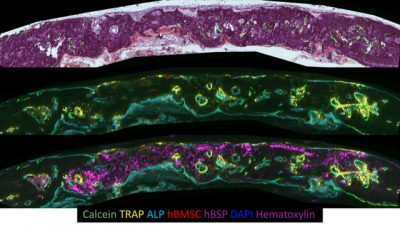
for bone regeneration. A unique tool being exploited in
these studies is the use of genetic fluorescent markers of
the bone cell lineage, which provides a means to evaluate
lineage decisions during osteogenic differentiation in
living tissue, and to FACS-isolate specific progenitor cell
populations for evaluation of their suitability for repair
of long bone fractures and critical-size skull defects.
Research in cartilage is investigating the genes
and signals which control the initial
differentiation of chondrocytes from limb
mesenchymal cells, and their subsequent progressive
maturation, during formation of the limb skeletal
elements. Studies are also investigating the
formation and specification of the joints which form
between the limb cartilage elements, and the
differentiation of the cartilage that comprises the
joint surface. Investigators are also directing the
differentiation of human stem cells into cartilage
for the purpose of joint repair. These studies
will help us to understand and ultimately treat,
debilitating human conditions affecting the skeleton
including chondrodysplasia and osteoarthritis.
Research is also underway to investigate the
development and maintenance of skin, and the
mechanisms of dermal wound healing, including the
abnormal healing that occurs in the skin of patients
with keloids in which excessive scar tissue forms in
response to injury. Studies are in currently in
progress to identify the genetic basis for human
keloid formation.
|
|
Center members conducting research on Bone, Cartilage and
Skin Differentiation include:
|
Research on Bone, Cartilage and Skin Differentiation is
interdisciplinary and involves interaction with UConn Health
Center
investigators in the:
|
[back to top]
|
|
|
The study of craniofacial and tooth development
encompasses a broad area of research that
investigates the control of cartilage, bone and
tooth differentiation, as well as proper positioning
and growth of the face, skull and teeth.
Research in Craniofacial and Tooth Development
ongoing in the Center for Regenerative Medicine and
Skeletal Development includes investigation of the
role of transcription factors in epigenetic control
of craniofacial and skeletal development, and in
regulation of tooth cell development and
differentiation. Studies are directing the
differentiation of periodontal and dental pulp
progenitor cells into osteoblasts and odontoblasts,
potentially useful for craniofacial bone and tooth
restoration, and stem cells are being used to model
early differentiative events important for
craniofacial morphogenesis. Investigators are also
working to identify the genetic and molecular
mechanisms responsible for the human congenital
disorders craniometaphyseal dysplasia, cherubism,
and Willimas-Bueren syndrome, which cause
craniofacial abnormalities due to disruption of
normal differentiation pathways.
|
|
Center members conducting research in the area of
Craniofacial and Tooth Development include:
|
Interdisciplinary research in Craniofacial and Tooth
Development involves collaboration with members
of the:
|
[back to top]
|
|
|
Studies on vertebrate embryonic limb development have
been conducted by a group of investigators within the Center
for Regenerative Medicine and Skeletal Development in the
context of an NIH Limb Program Project which has been
continuously funded for nearly 20 years. These
studies are investigating the molecular mechanisms
that control limb formation and growth, including
transcriptional control of limb patterning, growth
factor signaling during initial limb specification
and outgrowth, and the role of the extracellular
matrix in limb patterning including specification of
the limb skeletal elements and joints. Research is
also investigating the involvement of signals and
factors which are important in limb patterning in
mediating embryonic limb regeneration.
|
|
Center members conducting research in the area of Limb
Development and Regeneration include:
|
The Limb Program Project also involves participation by investigators at
other institutions such as:
- Yale University
- University
of South Carolina School of Medicine
- Tulane University
|
[back to top]
|
|
|
Exciting potential exists for stem cell based therapies
in the regeneration and repair of human bone or cartilage
lost to injury, disease, or age. Cutting-edge research in
the Center for Regenerative Medicine and Skeletal
Development is already underway to evaluate the efficacy of
various types of stem cells for skeletal tissue restoration,
including adult bone marrow mesenchymal cells which contain
subpopulations of osteogenic progenitors; pluripotent stem
cells obtained from human embryos (hESC), and pluripotent
stem cells derived from adult human fibroblasts (iPSC),
which may be generated from the skin of the specific patient
that needs repair.
A major award from the State of
Connecticut Stem Cell Research Initiative has funded
interdisciplinary and multidisciplinary research in stem
cells being conducted by several members of the Center for
Regenerative Medicine and Skeletal Development in the area
of musculoskeletal tissue regeneration. This award is a
Group Project Grant in which investigators are exploring
directed differentiation of stem cells into the
musculoskeletal lineage, including into bone and cartilage,
as well as the design and use of biomaterial scaffolds for
cell mediated repair, and the genomic analysis of skeletal
progenitor populations. Specific stem cell related projects
ongoing by Center members include isolation, evaluation and
use of adult bone marrow derived stem cells for repair of
long bone fractures and critical-size skull defects;
directed differentiation of human stem cells into the
cranial neural crest cell lineage for the purpose of
regeneration of craniofacial tissue including teeth;
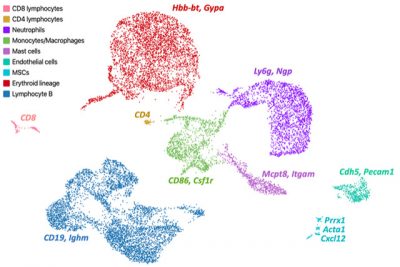
utilization of fluorescent genetic markers of the
musculoskeletal lineage to identify progenitor populations
with unique regenerative capabilities; generation of
biomaterials for delivery of stem cell based therapies; and
directed differentiation of human stem cells into bone and
cartilage for the purpose
of bone and joint repair.
- For more about the State of Connecticut Group Project
award to investigators in the Center for Regenerative
Medicine and Skeletal Development for stem cell research,
see the UConn Health Center magazine feature article:
"Unlocking the Secrets of Embryonic Stem Cells" (PDF).
- For an update on the progress being made by
investigators in the Center for Regenerative
Medicine and Skeletal Development in the area of
stem-cell based regeneration of cartilage for
the purpose of joint repair, read the recent
newspaper article in the Waterbury Republican: “UConn
Researchers Take First Step Toward Arthritis
Treatment.”
|
|
Center members conducting research on the use of Stem
Cells for Skeletal Tissue Regeneration and Repair include:
|
Stem cell research in the Center for Regenerative
Medicine and Skeletal Development involves collaborative
interaction with UConn Health Center investigators in the:
|
[back to top]
|
|