The central goal of my work is to identify progenitor
cell types with therapeutic potential to repair skeletal
damage. A necessary component of this work is to develop
strategies to isolate progenitor cell populations and
demonstrate their ability to terminally differentiate into
skeletal tissues. To this end, we utilize BACs and bacterial
recombination strategies to genetically engineer mice and
embryonic stem cells in a manner that allows us to mark,
isolate and determine the osteogenic potential of distinct
progenitor cell types.
Currently, my lab is focused on two
projects described below.
Project 1: Bone Marrow Derived Mesenchymal Stem Cells (BM-MSCs)
and Their Osteogenic Derivatives
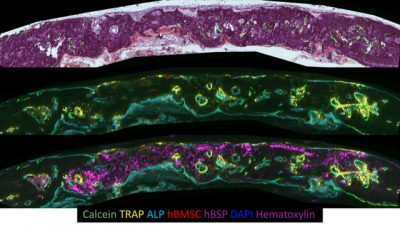
We have developed a
methodology to isolate BM-MSCs and their early osteogenic
progenitors from primary cultures. We define this cell
population as BM-MSCs based on their ability to
differentiate into osteoblasts, chondrocytes, or adipocytes
using defined culture conditions. Moreover, in collaboration
with Dr. Rowe, we have demonstrated the therapeutic
potential of isolated BM-MSCs to repair skeletal defects in
a parietal bone transplantation model. We have also
developed animal models that allow us to identify and
isolate the osteogenic derivatives of BM-MSCs.
Future
avenues of research include:
- Determining the appropriate
culture environment to maintain BM-MSCs as pluripotent
cells.
- Comparing the osteogenic repair potential of BM-MSCs
to their osteogenic derivatives.
- Determining the
longevity of different progenitor cell populations after
transplantation.
- Identifying key signaling molecules
that regulate the osteogenic differentiation of BM-MSCs.
Project 2: Embryonic Stem (ES) Cell Differentiation Along
the Axial Skeletal Lineage
With the isolation of human ES
cells and the conversion of adult somatic cells into induced Pluripotent Stem Cells (iPSCs), there is a heightened
interest in understanding how to direct the differentiation
of ES cells down various cell lineages. The generation of
skeletal progenitors from ES cells in vitro is a poorly
understood process. The reason for this is largely due to
the significant experimental limitations that exist,
including an inability to identify and isolate skeletal
progenitors from differentiated ES cell cultures.
Furthermore, there is no way to demonstrate their skeletal
potential by transplantation. Thus, it remains difficult to
carryout any meaningful studies that demonstrate the
therapeutic value of ES cell derivatives with regards to
skeletal repair.
To overcome these experimental limitations,
our current focus is on the generation of mouse ES cell
models that will allow us to identify progenitor cell types
and mature osteoblasts and chondrocytes. Our strategy
involves the multiplexing of fluorescent protein reporters,
which will allow us to view multiple reporter genes within
the same ES cell line. Once generated, these murine based ES
cell models will facilitate our ability to study the
differentiation of ES cells into cell types that contribute
to the formation of bone and cartilage.
[back to top]
Maye P, Becker S, Kasameyer E, Byrd N, Grabel L., 2000.
Indian hedgehog signaling in extraembryonic endoderm and
ectoderm differentiation in ES embryoid bodies. Mechanisms
of Development 94 (1-2):117-132.
Maye P, Becker S, Siemen H, Thorne J, Byrd N, Carpentino J,
Grabel L., 2004.
Hedgehog signaling is required for the differentiation of ES
cells into neurectoderm. Developmental
Biology 265 (1):276-290.
Maye, P., Zheng, J., Li, L., and Wu, D., 2004.
Multiple mechanisms for Wnt11-mediated repression of the
canonical Wnt signaling pathway. Journal of Biological Chemistry
279(23):24659-24665.
Kalajzic, I., Staal, A., Yang, WP., Wu, Y., Johnson, SE.,
Feyen, JH., Krueger, W., Maye, P., Yu, F., Zhao, Y., Kuo,
L., Gupta, RR., Achenie, LE., Wang, HW., Shin, DG., and
Rowe, D.W., 2005.
Expression profile of osteoblast lineage at defined stages
of differentiation. Journal of Biological
Chemistry 280(26):24618-26.
Jiang, X., Kalajzi, Z., Maye, P., Braut, A., Bellizzi, J.,
Mina, M., and Rowe, DW., 2005
Histological analysis of GFP
expression in murine bone. Journal of Histochemistry &
Cytochemistry 53(5):593-602.
Li, X., Liu, P., Liu, W., Maye, P., Zhang, J., Zhang, Y.,
Hurley, M., Guo, C., Boskey, A., Sun, L., Harris, S.E.,
Rowe, D.W., Ke, H.Z., Wu, D., 2005.
Dkk2 has a role in
terminal osteoblast differentiation and mineralized matrix
formation. Nature Genetics 37 (9):945.
Sawakami, K., Robling, AG., Ai, M., Pitner, ND., Liu, D.,
Warden, SJ., Li, J., Maye, P., Rowe, DW., Duncan, RL.,
Warman, ML., Turner, CH. 2006.
The Wnt co-receptor LRP5 is
essential for skeletal mechanotransduction but not for the
anabolic bone response to parathyroid hormone treatment.
Journal of Biological Chemistry 281(33):23698-711.
Boban,I., Jacquin, C., Prior, K., Barisic-Dujmovic, T., Maye,
P., Clark, SH., Aguila, HL. 2006.
The 3.6 kb DNA fragment
from the rat Col1a1 gene promoter drives the expression of
genes in both osteoblast and osteoclast lineage cells. Bone
39(6):1302-12.
Wang, YH., Liu, Y., Maye, P., Rowe, DW. 2006.
Examination of
mineralized nodule formation in living osteoblastic cultures
using fluorescent dyes. Biotechnology Progress
22(6):1697-701.
View more publications, see
Pubmed listing.
[back to top]
“Importance of Beta-Catenin Signaling in Osteocytes
Associated with Anabolic Bone Load,” (Kotha. S.P., PI) (Maye,
P., Co-PI) August 1, 2008 through May 31, 2013. The goal of this proposal
is to understand the temporal and spatial activation of
beta-catenin in response to anabolic load.
“GFP Reporters for the Chondrocyte Lineage,” (Rowe DW, PI)
(Maye, P., Co-PI). July 1, 2008 through June 30, 2010. The major goals of
this project are to create transgenic animal models that
retain fluorescent protein gene reporters to mark cell
populations that contribute to skeletal joint formation.
“Creating Multi-Gene Reporter Mice Via Recombineering,” (Lichtler
AC, PI)(Maye, P., Co-PI) July 1, 2006 through July 31, 2009. The major
goals of this project are to create a transgenic animal
model that retains multiple fluorescent protein gene
reporters identifying osteoblasts, osteocytes, and
osteoclasts.
[back to top]
Education
Ph.D., Wesleyan
University
Student and Postdoctoral Research Opportunities
Peter Maye is a faculty member in the
Skeletal,
Craniofacial and Oral Biology Graduate Program.
[back to top]
[back to top]